Let’s say a pump has a stated life expectancy of 20 years. Should a facility replace it at 18, or keep it running until 24?
That decision carries consequences for maintenance spending, production, and risk. A useful answer needs to account for the equipment’s operating history, environment, condition, and role in the facility. The number on a specification sheet can only tell part of the story.
At the recent Gulf Coast Industry Forum (GCIF) 2026, that pump became a practical example in a fireside conversation between Ryan Sitton, Pinnacle’s founder and CEO, and Peter Huntsman, Chairman, President and CEO at Huntsman Corporation.
Their discussion explored industrial competitiveness, artificial intelligence (AI), and leadership, with a recurring focus on the people and decisions that keep manufacturing moving.
For reliability and maintenance leaders, the conversation offered a useful test for any technology investment: how will it change what happens inside the industrial plant?
A Better Answer to the 20-Year Pump Question
Huntsman’s pump example brought the AI discussion into familiar territory for maintenance teams.
He questioned whether a stated service life adequately accounts for weather, climate, salinity, operating rates, and utilization. Under different conditions, the same nominal life expectancy could support very different replacement decisions.
The example was hypothetical. Huntsman wasn’t reporting a finding that a particular pump should run longer or be replaced sooner. He was describing an opportunity to use technology to examine the factors behind a maintenance decision more closely.
The reliability implications extend beyond that individual pump. A replacement decision also depends on what failure would mean for production, whether another asset can perform the same duty, and what competing work requires the same budget or crew.
Replacing equipment early may bring unnecessary spending forward. Extending its service life may increase exposure if the evidence doesn’t support continued operation. Both choices deserve a clear explanation.
This is where analysis becomes useful to the business. It helps a team compare options, understand uncertainty, and explain why a particular action belongs in the plan.
A maintenance leader should be able to defend that decision to operations and finance. The engineer reviewing the equipment should understand the assumptions behind it. The crew carrying out the work should know what the intervention is intended to accomplish.
Every AI Project Needs a Business Case
Huntsman’s enthusiasm for AI came with a direct question: “Does it make money?”
That question puts the operational purpose of a project first. It asks teams to establish what will improve, how they will measure it, and whether the improvement justifies the investment.
He offered an example from Huntsman’s aerospace business. Responding to regulatory requests about product formulations and toxicity history would, he estimated, have required six to twelve months of work. With existing data organized in a database and AI helping the team use it, he said the response took less than a week.
The example concerned regulatory documentation rather than maintenance. Its relevance is the connection between a defined task, available information, and a result that people could recognize.
Reliability projects need the same discipline. Before introducing another analytical tool, leaders should identify the decision it will support. That might mean selecting work for an upcoming turnaround, deciding whether to repair or replace equipment, or directing limited maintenance resources toward the largest threats to availability.
The business case should follow that decision through to execution. Time saved in analysis matters most when teams use it to resolve priorities, prepare work, or address an issue sooner. A more sophisticated recommendation still needs an owner, resources, and a practical path into the field.
Leaders Need to Understand the Work They Fund
When the discussion turned to actions companies could take within their own walls, Huntsman’s answer started with time in a facility.
He wanted employees across functions, including finance and human resources, to understand how products are made and why the people doing that work need support. He connected this view to his own experience, which included truck driving and work in manufacturing plants before moving into leadership.
That experience matters because decisions made away from the facility eventually reach someone working inside it.
A budget determines whether a repair can proceed. A staffing decision affects whether experienced people are available. A training investment influences how confidently an employee can recognize and respond to an abnormal condition.
Huntsman challenged the tendency to treat operational failures as the actions of individuals alone. People generally arrive at work intending to do their jobs well. Companies also shape the conditions in which those jobs happen.
“We fail as companies. We fail to fund properly. We fail to train properly.”
– Peter Huntsman
For reliability leaders, this makes execution part of the investment decision. A maintenance recommendation needs to reflect the skills, time, access, and resources required to complete it.
Understanding those constraints helps leadership ask better questions. It also gives facility teams a clearer opportunity to explain what they need before a plan becomes a commitment.
That shared understanding helps build a reliability culture across the organization.
Following the System Can Become a Risk of Its Own
Near the end of the conversation, Sitton raised a concern from his experience working with industrial customers.
As databases, rule sets, and formal workflows became more common in plants, he had seen a shift in how some people approached their work. Operating the system could begin to take the place of examining the situation. Capable employees could walk past an issue because their attention had narrowed to completing the prescribed process.
That observation deserves care. Formal processes support consistent work, documentation, and accountability. Their usefulness also depends on people recognizing when conditions require closer attention.
A completed workflow records that a process was followed. A sound reliability decision requires teams to consider whether the information is current, whether assumptions still hold, and whether the recommended action fits the facility’s circumstances.
Huntsman’s response emphasized discussion, human connection, and the willingness to challenge ideas.
“Take ideas, rip them apart, and put them back together.”
– Peter Huntsman
Applied to reliability, that means creating room for engineers, operators, maintenance teams, and leaders to question a recommendation together. A concern from the field should be able to change the analysis. An unexpected inspection result should prompt a review of the assumptions behind the plan.
Technology should make that conversation more informed and easier to resolve.
Connecting Reliability Decisions to Facility Performance
These themes align closely with Pinnacle’s approach to Data-Driven Reliability.
Industrial organizations need to connect equipment information with the decisions that affect the facility. The pump’s condition matters, alongside its contribution to production, the consequences of failure, and the effect of competing maintenance choices.
Newton is Pinnacle’s Reliability Decision Platform. It forecasts facility availability, quantifies business impact, and prioritizes what to do next. Its role is to give teams a clearer basis for comparing reliability decisions and explaining their consequences.
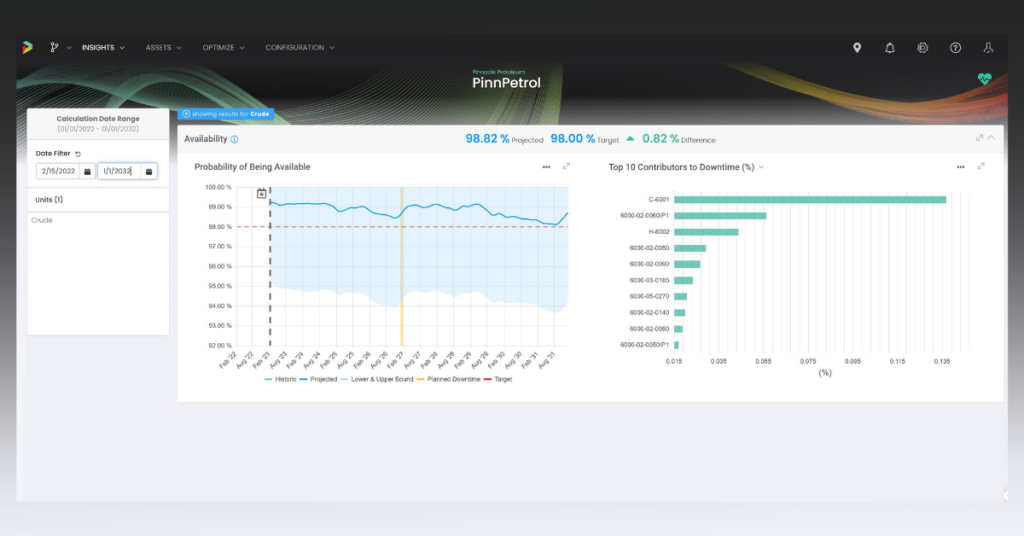
Pinnacle combines that technology with reliability strategy and engineering execution. Together, those elements help customers establish what matters, evaluate the options, and carry agreed decisions into the work plan.
The connection to the GCIF conversation is practical. Better information about a pump can support a better maintenance choice. Facility context helps establish its priority. Engineering review tests the recommendation. People then arrange and carry out the work.
That sequence gives technology a specific job and keeps responsibility visible. It also makes the value easier to assess: the team can explain what changed in the decision, why it changed, and what business effect it expects.
The GCIF conversation offered a practical test for technology: what will the facility do differently because of it?
AI can speed up analysis, reliability modeling can clarify trade-offs, and people determine whether those answers lead to useful work.
Before approving your next reliability investment, identify the decision it should improve, the evidence your team needs, and how the work will get done. Judge its value by the risk addressed, unnecessary work avoided, or availability supported.
Talk to a Reliability Expert about connecting your facility’s data to clear priorities and a practical plan.