If your team could address one piece of equipment to improve facility availability, could you explain which one deserves attention first and why?
You’ve invested in an asset performance management (APM) system. It holds data, strategies, and recommended tasks. Yet your team may still struggle to justify what comes first. If your APM leaves you guessing where to spend, its return is hard to defend.
The gaps become costly when it leaves you with:
-
- Asset rankings that don’t explain facility impact
- Recommended work without a quantified cost-benefit case
- Spending plans disconnected from the risks that matter most
Here are three ways to assess whether your APM helps you improve facility availability, justify spending, and address health, safety, and environmental (HSE) risk.
1. Connect Equipment Priorities to Facility Availability
An asset strategy explains how to manage equipment. A facility plan must also show how that equipment affects the wider operation. Understanding each asset’s contribution to expected downtime gives engineers and operations leaders a shared basis for prioritizing work.
“The equipment contributing most to facility downtime gives your team a clear starting point for review. ”
Newton, Pinnacle’s reliability decision platform, connects its availability forecast with the equipment driving expected downtime. Teams can narrow their review from:
-
- The facility’s projected availability
- To the process unit contributing most to downtime
- To the equipment driving that contribution
This helps teams identify where to focus attention first. Engineers can evaluate failure mechanisms, available actions, and practical constraints to choose work that addresses the facility’s priorities.
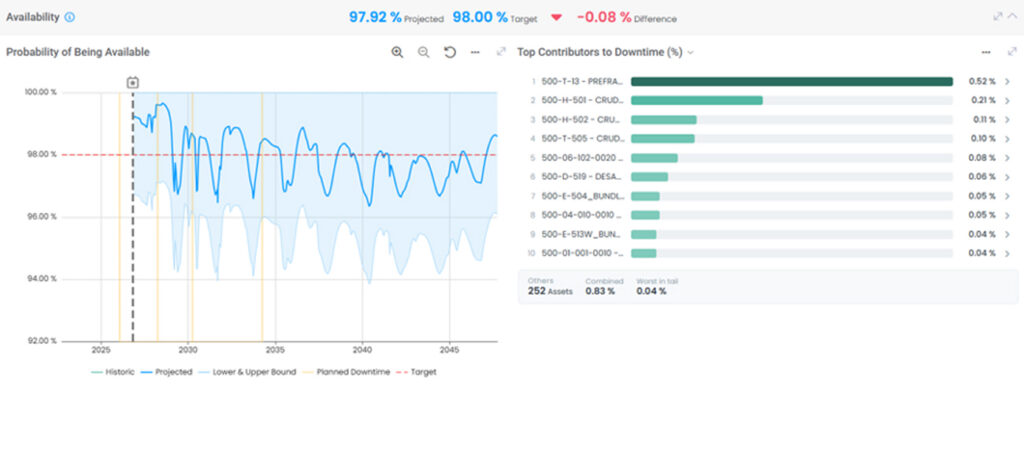
Newton connects projected facility availability with the equipment contributing most to downtime.
2. Compare the Cost of Work with Its Expected Benefit
A recommendation needs a financial basis alongside its technical justification. Teams must compare what the work costs with what it is expected to deliver.
For an availability improvement, estimate the production value of the forecast change over a defined period, then compare it with the proposed work’s cost.
Newton brings availability, risk, and task costs into that evaluation. Teams can review spending over time, compare units and asset types, and drill into individual assets to see the tasks behind their costs.
Seeing where the money goes helps teams check whether spending matches the facility’s priorities. A mismatch may justify:
- Moving resources between assets
- Adjusting the scope of work
- Changing when the work happens
Expected benefits remain forecasts until results are verified. After execution, teams should compare actual results with expectations to assess the investment and use what they learn to guide future spending decisions.
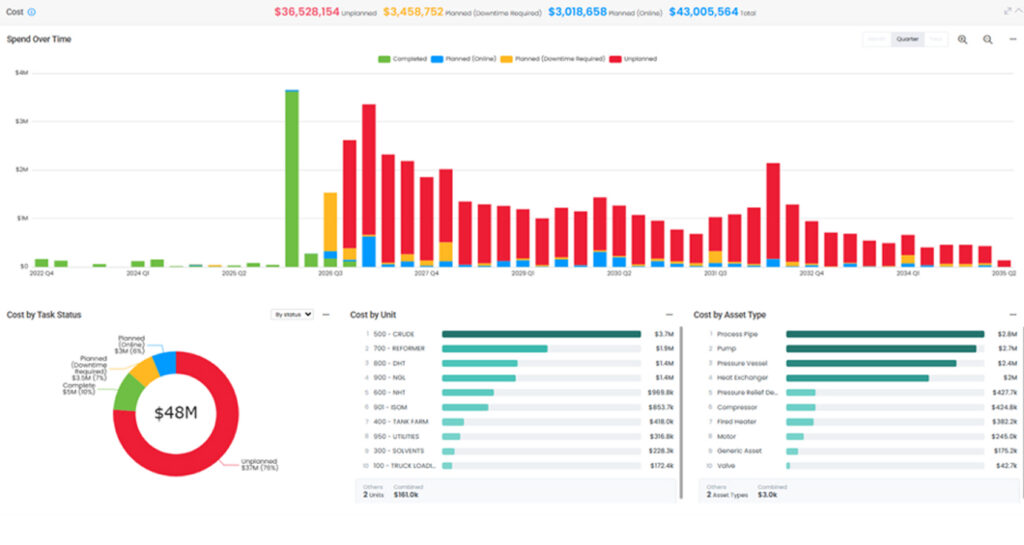
Newton displays spending over time and cost breakdowns by task status, unit, and asset type.
3. Evaluate Safety Risk Alongside Production Impact
The equipment driving downtime may differ from the equipment presenting the greatest HSE risk. Equipment with little production impact can still pose a serious hazard, such as a toxic release.
Teams need to assess both consequences when deciding where to act.
Newton shows modeled HSE risk over time and its leading contributors. Alongside the availability forecast, this helps teams identify assets that warrant attention despite a small downtime contribution.
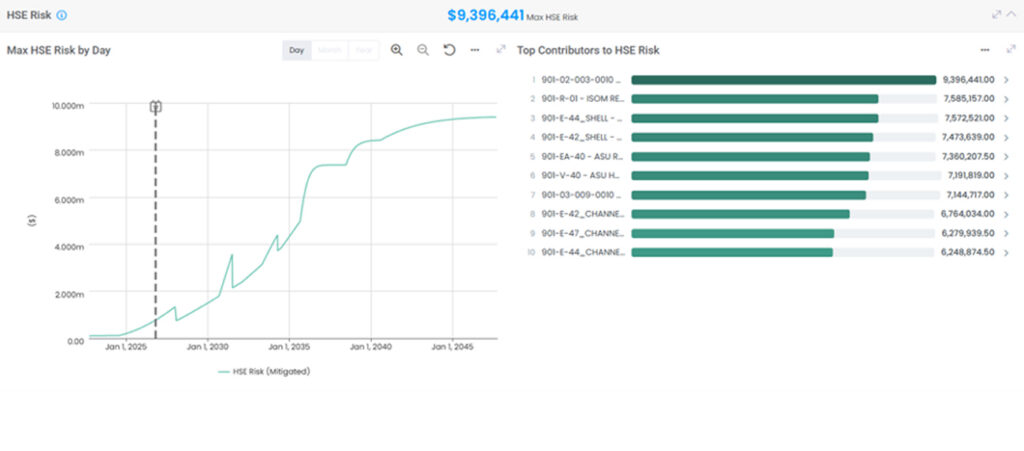
Newton shows modeled HSE risk over time and the assets contributing most to that risk.
Before choosing the work, engineers must review:
-
- The assumptions behind the risk estimates
- The available actions and their expected effects
- Applicable safety requirements and required controls
Financial comparisons help teams evaluate options. Safety obligations remain part of the decision, regardless of production impact.
From Asset Strategies to Facility Priorities
These decision areas provide a practical way to compare an asset-focused APM approach with Newton and Pinnacle’s broader support.
|
Decision area |
Traditional APM approach |
Newton and Pinnacle’s approach |
|---|---|---|
|
Prioritizing work |
Build strategies for individual assets |
Prioritize work using each asset’s contribution to facility downtime and risk |
|
Justifying spend |
Use risk rankings and thresholds to guide action |
Compare proposed work costs with expected availability and risk benefits |
|
Following through |
Organize strategies and recommended tasks |
Connect quantified priorities with engineering review and execution support |
Make Your Next APM Review About a Specific Decision
To assess what your APM is delivering, choose one recent reliability decision and work through it with your team:
-
- Which asset or task received priority, and what evidence supported that choice?
- How did the team assess its effect on facility availability and HSE risk?
- What did the proposed work cost, and what benefit was expected over the same period?
- What action followed, and how will the team check the result?
Answering these questions give you a concrete basis for assessing your APM’s value. Pinnacle’s Managed Reliability approach connects strategy, Newton, engineering judgment, and execution support to help teams prioritize work and follow through.
Ready to connect your reliability spend with facility priorities?