Artificial Intelligence (AI) is now embedded in daily operational decisions. From maintenance prioritization to production forecasting, teams increasingly use AI-driven insights to operate efficiently. In practice, however, strong model performance does not automatically guarantee reliable operational outcomes.
AI models and analytics can meet accuracy and validation targets, but unplanned downtime, safety exposure, and cost overruns may still occur. The issue is rarely the quality of the model itself. More often, it is the assumption that reliability can be achieved by optimizing models rather than by engineering decisions at the operational level.
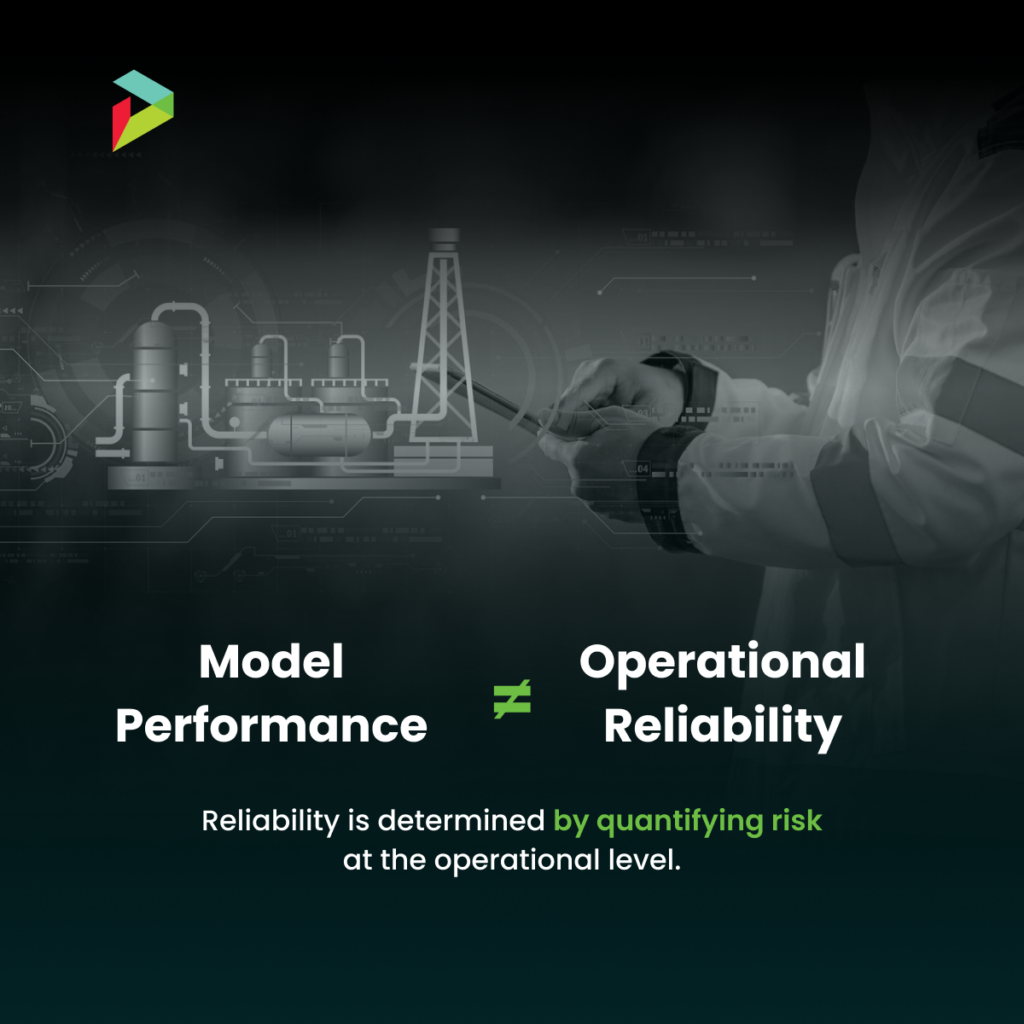
Reliability is not determined by how a model performs in isolation. It is defined by how decisions affect real assets, systems, and outcomes over time—an issue Quantitative Reliability Optimization (QRO) is specifically designed to address by quantifying operational risk and decision impact beyond model metrics.
Why Model Performance Metrics Fall Short in Operations
Model performance metrics describe behavior within defined boundaries. They answer questions like: Did the model classify correctly? Did it detect the pattern it was trained to find? These metrics are essential for development and validation, but they fall short when it comes to guiding operational decisions.
Operational environments are dynamic. Equipment degrades, operating conditions fluctuate, and assets interact in ways that models are not designed to fully capture. A model can be technically correct and still drive a decision that increases risk because the surrounding system has changed.
This is why organizations often experience a disconnect between successful AI deployments and operational results. Dashboards show stable model performance, yet failures emerge in production and asset availability. The model metrics never accounted for uncertainty, time-based degradation, or system-level consequences.
From a reliability perspective, this creates a false sense of confidence. Decisions appear justified, but risk accumulates quietly until it surfaces as downtime or loss.
Reliability Decisions Require Quantified Risk
Operational reliability depends on understanding risk in measurable terms. Leaders need to know not only what is happening, but what is likely to fail, when it may fail, and what the consequences would be if it does.
AI outputs typically provide signals or recommendations, but they do not offer a quantified comparison of options. Alerts may indicate concern, yet they do not explain whether acting now meaningfully reduces risk or simply shifts work forward.
When reliability decisions rely primarily on qualitative scoring or expert interpretation, prioritization becomes inconsistent. Different teams draw different conclusions from the same data, leading to over-maintenance in some areas and under-management in others.
But when risk is calculated, reliability improves. Quantifying the Probability of Failure (PoF) over time and linking it to business and production impact allows decisions to be compared and prioritized on a common basis. Without that quantification, AI remains an input to decision-making, not a framework for making consistent, defensible operational choices.
How QRO Makes AI-Enabled Decisions Reliable
Quantitative Reliability Optimization (QRO) focuses on operational outcomes rather than model performance. It does not attempt to optimize AI algorithms or replace existing analytics. Instead, QRO evaluates how decisions affect reliability across assets and systems.
Using live, data-driven modeling, QRO auto-calculates the Probability of Failure (PoF) as conditions evolve. Uncertainty is explicitly modeled, allowing teams to see the expected outcomes, the range of possible outcomes, and their likelihoods. It also accounts for system-level interactions. Assets are evaluated based on how their failure would affect production, safety, and downstream operations. AI-generated insights feed into this model as one of many data inputs, alongside inspection data, operating conditions, and historical performance.
Most importantly, QRO links actions to value. Maintenance tasks, inspection deferrals, and investment decisions are compared based on the risk reduction they achieve and their impact on availability and cost. This enables teams to make consistent, risk-informed decisions that withstand operational and business scrutiny.
Reliability Is Determined in the System, Not the Model
AI improves visibility, but visibility alone does not create reliability. Operational reliability is determined by how decisions perform across real systems over time, not by how models score in controlled testing environments.
Organizations that consistently quantify risk outperform those that rely solely on metrics and alerts. Quantitative Reliability Optimization provides a structured, engineered approach for evaluating risk, comparing decisions, and sustaining reliable outcomes in day-to-day operations.
When reliability is treated as a calculated variable instead of an assumption, AI finally becomes a dependable operational advantage.
Visit Pinnacle Reliability and explore how QRO helps teams connect data, decisions, and outcomes. Connect with the Pinnacle team to continue the conversation.