AI predictive monitoring has become a foundational capability across industrial and asset-intensive operations. By analyzing patterns, trends, and deviations, these systems promise earlier awareness of emerging issues and the ability to intervene before failures occur. In pilot environments, predictive monitoring often enables timely alerts, signal detection, and improved visibility.
However, when predictive monitoring is scaled into live production environments, its limitations are apparent. Many organizations discover that while they can see more, they still struggle to decide what to do, when to act, and which risks truly matter. The challenge is usually not a lack of data or analytics, but the absence of quantified reliability and decision context.
This is where Quantitative Reliability Optimization (QRO) becomes essential, extending predictive monitoring from awareness to quantified, system-level reliability decisions.
The Core Strengths and Limitations of Predictive Monitoring in Production
Predictive monitoring excels at condition awareness. It continuously evaluates incoming data, detects anomalies, and flags deviations that may indicate degradation or abnormal behavior. This capability is valuable, particularly in complex systems where human monitoring alone is insufficient.
The problem begins when signals are expected to serve as decision logic. An alert indicates that something has changed, but it does not explain the likelihood of failure or the severity of the outcome. As systems scale, alerts tend to multiply faster than teams’ capacity to interpret them. Over time, this leads to alert fatigue, conservative decision-making, or inconsistent responses across teams.
While AI predictive monitoring improves visibility into changing conditions, it was not designed to quantify reliability or support system-level decision-making in production environments. As a result, several structural limitations remain.
1. No Quantified Probability of Failure
Predictive monitoring does not auto-calculate how likely the changing conditions will result in failure. Teams are left to interpret risk using experience or assumptions, which introduces subjectivity and inconsistency into decision-making.
2. No Modeling of Consequences
Most alerts are not connected to quantified impact. Without visibility into production loss, safety exposure, or economic cost, low-impact issues and high-consequence risks often appear equally urgent, making prioritization difficult.
3. Asset-Level Insight in a System-Level World
Predictive monitoring typically evaluates assets in isolation, while production performance is driven by interconnected systems. Local issues can cascade across operations, yet monitoring alone does not account for these system-level interactions.
Reliability Decisions Require Quantified Risk
Production environments operate under uncertainty by default. Data is incomplete, operating conditions evolve, and system interactions amplify risk. Under these conditions, decision-making requires more than early warning. It requires quantified reliability and prioritization.
Operations teams need answers to practical questions: Which risks are most likely to materialize? What actions reduce the most exposure? What work can be safely deferred without increasing risk? Predictive monitoring identifies change but does not provide a structured way to consistently answer these questions.
To move from awareness to control, organizations need a reliability framework that translates signals into measurable risk and actionable decisions.
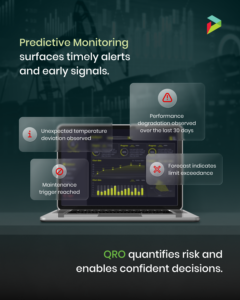
How Quantitative Reliability Optimization (QRO) Extends Predictive Monitoring
Quantitative Reliability Optimization (QRO) extends predictive monitoring by embedding it within a probabilistic, system-level reliability model. Rather than replacing monitoring tools, QRO uses data as inputs to continuously auto-calculate the Probability of Failure (PoF) and its consequences as conditions change.
QRO integrates inspection data, operating conditions, maintenance history, and real-time signals into a unified model. Using probabilistic methods, it evaluates not only whether degradation is occurring, but also how likely it is to lead to failure and what the impact would be if it does. Reliability is assessed across individual assets and rolled up to the system level, capturing interdependencies and cascading effects.
This approach shifts decision-making from alert-driven response to risk-informed prioritization. Actions are evaluated based on their ability to reduce quantified risk and improve outcomes, not on perceived urgency or static thresholds. QRO makes uncertainty visible and measurable, allowing teams to act with confidence rather than assumption.
From Signals to Reliable Decisions
AI predictive monitoring remains an important capability, but in production, it is only a starting point. Signals without probability, consequence, and system context leave organizations reacting.
Reliability requires more than early detection. It requires understanding which risks are most likely to materialize, how their impact compounds across systems, and which actions create measurable value. Quantitative Reliability Optimization (QRO) provides this missing layer by transforming monitoring data into quantified, system-level reliability insight.
As AI continues to influence higher-consequence operational decisions, organizations that move from monitoring toward measured reliability will be better positioned to achieve consistent performance and defensible decision-making at scale.
Learn how Pinnacle Reliability’s QRO can help organizations make that transition.