Semi-quantitative models were developed when data access and computing power were still limited. They rely on deterministic inputs, conservative assumptions, and relative scoring. As a result, they often generate misleading failure predictions—either inflating or underestimating true Probability of Failure (PoF). This leads to:
- Over-inspection of low-risk assets
- Missed early signs of degradation
- Turnaround scopes bloated by “just-in-case” tasks
- Difficulty connecting reliability actions to availability and cost outcomes
In short, these models require engineers to plan based on assumptions rather than data-driven evidence.
Modern facilities deserve a model that keeps up with how they actually operate: dynamic, data-rich, and system-dependent. For industrial teams navigating plateaued performance and rising complexity, Quantitative Reliability Optimization (QRO) offers a measurable step-change in how reliability decisions are made. Here’s why.
What Makes QRO a Transformational Model
QRO unifies all reliability data into a single, fully quantitative system model. Every asset, failure mode, degradation curve, cost driver, and production dependency is evaluated using the same logic and without human interpretation skewing outcomes.
The Newton™ engine automates thousands of calculations in minutes, allowing engineers to see:
- How an asset is degrading
- How uncertainty affects predictions
- Which tasks matter most
- How actions influence availability, cost, and risk
This level of clarity fundamentally changes how facilities plan and prioritize.
The Measurable Impact of QRO
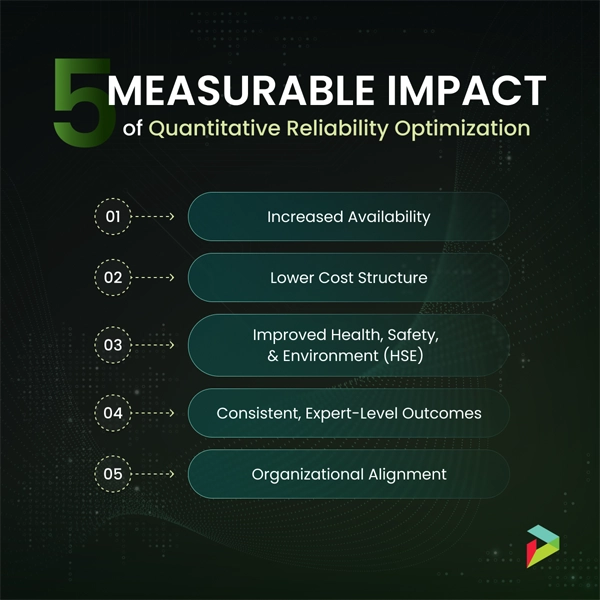
With QRO embedded into daily workflows, facilities consistently achieve:
Increased Availability
QRO improves availability by identifying failure modes and assets that have the greatest impact on production. Teams can adjust maintenance timing, prioritize inspections, and address high-impact issues before they affect operations. This approach reduces unplanned interruptions, improves the effectiveness of planned work, and supports more stable, predictable performance over time.
Lower Cost Structure
QRO helps facilities safely defer low-value inspections, refine preventive maintenance, and focus resources on activities that deliver measurable improvement. In one deployment, QRO helped eliminate more than 10,000 non-value inspections, generating $5.3M in savings on a $125k investment, with a broader sitewide opportunity of approximately $35M.
Improved Health, Safety, and Environment (HSE)
QRO’s Lifetime Variability Curve (LVCs) provide early visibility into degradation patterns, including those that traditional deterministic approaches often overlook. By clarifying where uncertainty is concentrated and which mechanisms present rising risk, QRO supports stronger mechanical integrity and more effective mitigation strategies. This reduces the likelihood of leaks, in-service failures, and other HSE-critical events.
Consistent, Expert-Level Outcomes
QRO applies the same quantitative methodology across every asset and failure mode, reducing reliance on judgment-driven estimates and minimizing SME bias. Engineers at all experience levels can access consistent, defensible insights. Reliability decisions become repeatable and aligned with measurable outcomes, whether reviewed internally, audited, or used to guide long-term planning.
Organizational Alignment
QRO gives teams a unified, facility-wide reliability model that replaces subjective prioritization with a consistent, data-driven framework. Availability becomes the common language across maintenance, inspection, operations, and leadership. Every task is tied to its impact on production and risk, enabling more strategic planning and stronger alignment across the organization.
The Path Forward
Semi-quantitative may have served the industry well, but the next level of reliability performance requires more than incremental improvements. It requires a shift to fully quantitative, system-level modeling that captures uncertainty, predicts degradation more accurately, and connects every decision to availability, safety, and cost.
Quantitative Reliability Optimization (QRO) gives facilities that capability today.
If your reliability program has plateaued, or if you’re exploring a path to higher availability through smarter, more defensible decisions, now is the time to evaluate QRO as a strategic advantage.
Explore Pinnacle now or contact our team to learn how QRO can significantly improve your reliability.