Many reliability issues tied to new assets are not primarily caused by design or construction defects. They are created during the transition of assets from project delivery to regular operation. Decisions made before startup significantly influence inspection plans, maintenance workloads, downtime exposure, and long-term cost.
An effective Operational Readiness Review (ORR) provides a structured approach for industries to manage uncertainty before it becomes a recurring problem. It creates alignment and visibility, helping teams understand how the asset will operate within the broader system, where early risks are most likely to appear, and which assumptions require validation after startup.
Many readiness reviews focus on whether an asset can start, rather than whether it is ready to operate reliably. When readiness ends with mechanical checks and procedures, unknowns are pushed into operations. This often leads to overly broad inspection programs, low-value maintenance tasks, and unexpected downtime during the early years of service.
Operational readiness should connect project intent to operational reality. It provides engineering, maintenance, and operations with a shared view of risk before startup, when changes are easier to make and easier to justify.
How to Prepare New Assets for Reliable Operation
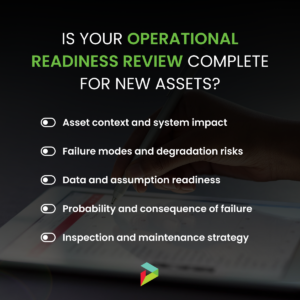
An effective ORR does not need to be complex. It needs to focus on the areas that most often drive early-life reliability risk.
- Asset context and system impact
Define asset boundaries and system dependencies. New assets rarely fail in isolation. Understanding how the asset interacts with upstream and downstream equipment, utilities, controls, and operating constraints is critical. This step also identifies single points of failure that could affect production, safety, or environmental performance. - Failure modes and degradation risks
Document known failure modes and degradation mechanisms based on design, materials, operating conditions, and experience with similar assets. Identify where assumptions are being made and where uncertainty is highest. New assets often carry unknown risks related to early wear, process variability, operating discipline, or control strategy. - Data and assumption readiness
New assets enter service with limited operating data. The goal is to understand what information is available at startup, what is missing, and which gaps matter most. Vendor data, design inputs, and subject-matter expertise provide an initial baseline, but they should be treated as starting points rather than fixed answers. - Probability and consequence of failure
Rather than relying on single-point risk scores, readiness reviews should establish an initial, quantified range for the Probability of Failure (PoF) and explicitly link it to realistic consequences. This includes production impact, safety exposure, environmental risk, and cost. Doing so prevents low-impact issues from receiving the same level of attention as high-consequence risks. - Inspection and maintenance strategy
Inspection and maintenance plans should be tied directly to failure mechanisms. Early-life inspections should focus on reducing uncertainty rather than adhering to inherited or generic intervals. Maintenance tasks should be reviewed to avoid over-maintenance while ensuring critical risks are effectively addressed.
Strengthening Operational Readiness with QRO
One of the greatest challenges with new assets is managing uncertainty without relying solely on individual judgment. This is where Quantitative Reliability Optimization (QRO) adds real value to the readiness process.
QRO provides a structured approach to integrating data, engineering principles, and uncertainty into a single, coherent model. Instead of locking in static assumptions, QRO enables teams systematically update the Probability of Failure (PoF) as operating and inspection data becomes available. Early estimates are continuously refined, allowing readiness decisions to evolve alongside real asset behavior.
By linking probability and consequence directly to production and cost outcomes, QRO helps teams prioritize actions based on impact rather than intuition. Inspection plans, maintenance timing, and early adjustments become easier to justify because they are grounded in quantified risk, not intuition. Operational readiness shifts from a one-time approval gate to a continuously updated process that matures as uncertainty is reduced and real operating data is obtained.
Operational Readiness is the First Reliability Decision
New assets set their reliability trajectory early. When uncertainty is not addressed properly at startup, it resurfaces later as unplanned downtime and escalating costs. A disciplined Operational Readiness Review does not eliminate risk but instead makes risk visible and manageable.
By focusing on system context, failure mechanisms, and quantified risk, teams can enter operation with clearer priorities and fewer surprises. With QRO in place, operational readiness shifts from checklist compliance to a deliberate, risk-informed reliability decision.
If you are preparing to start a new asset, QRO can help you identify and manage early uncertainty before it becomes a long-term reliability risk. Learn more here!